
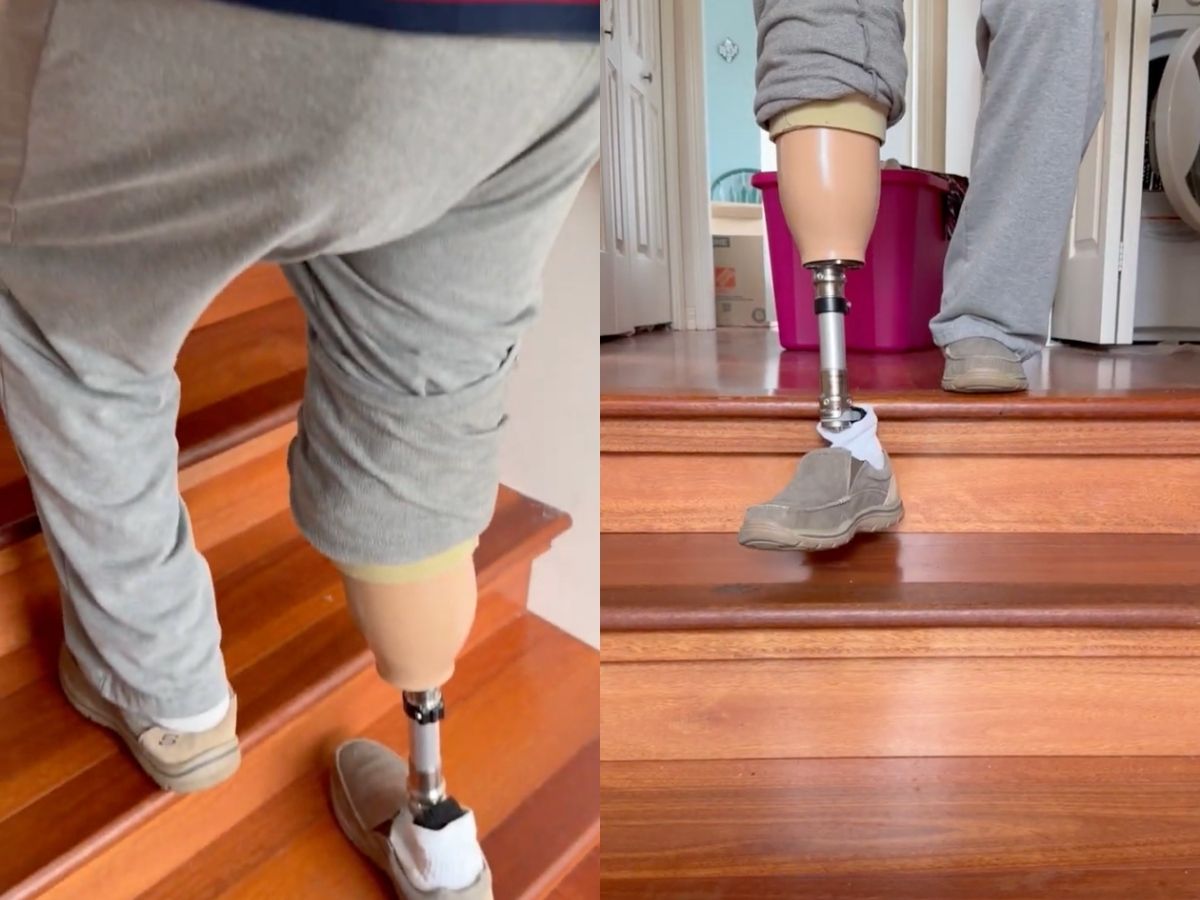
Learn how to safely go up and down stairs with an injured or weaker leg. Fisiomed Mobile Clinic provides in-home physiotherapy in Surrey, Langley, White Rock, Delta, and Richmond.
Stairs can be one of the most challenging parts of recovering from a leg injury or surgery. Pain, weakness, reduced balance, and weight-bearing restrictions can make an everyday staircase feel intimidating.
A simple rule can help many patients remember which leg should move first:
“Up with the stronger leg, down with the injured leg”
When going upstairs, lead with the stronger or unaffected leg. When going downstairs, lead with the injured, operated, or weaker leg.
This is generally performed as a step-to pattern, meaning both feet meet on the same step before the person moves to the next one.
Why Does the Stronger Leg Go Up First?
Climbing a step requires the leading leg to lift the body against gravity. By placing the stronger leg on the next step first, you can use that leg to help raise your body.
The injured or weaker leg then follows onto the same step without having to perform most of the lifting.
Why Does the Injured Leg Go Down First?
Going downstairs requires you to lower your body in a controlled manner.
When the injured leg moves to the lower step first, the stronger leg remains on the higher step and helps control the descent. This reduces the amount of lowering work required from the injured or weaker leg.
How to Go Upstairs With an Injured Leg
If your physiotherapist has approved this technique:
- Approach the stairs and stand close to the first step.
- Hold a secure handrail whenever one is available.
- Place the stronger or unaffected leg on the next step.
- Push through the stronger leg to raise your body.
- Bring the injured or weaker leg onto the same step.
- Move your cane or crutch according to the sequence taught by your physiotherapist.
- Repeat one step at a time.
A common sequence for patients using a crutch is:
Stronger leg → injured leg → crutch
This is sometimes remembered as ABC:
- A: Able leg
- B: Injured or weaker leg
- C: Crutch
How to Go Downstairs With an Injured Leg
When descending:
- Stand close to the edge of the step without allowing your toes to extend over it.
- Hold the handrail securely.
- Place the cane or crutch on the step below, if applicable.
- Move the injured or weaker leg down to that step.
- Bring the stronger leg down to meet it.
- Repeat slowly, one step at a time.
A common sequence when using a crutch is:
Crutch → injured leg → stronger leg
This reverses the upstairs sequence.
Hospital stair-training guidance similarly teaches patients to lead upstairs with the unaffected leg and downstairs with the affected leg. See the University Hospitals Plymouth instructions.
Stair-Safety Tips During Injury Recovery
Use the handrail
Use a secure handrail whenever possible. Your physiotherapist can show you how to manage a cane or crutches while keeping one hand available for the rail.
Take one step at a time
During early recovery, avoid alternating feet as you normally would. Bring both feet onto the same step before continuing unless your physiotherapist has determined that a reciprocal pattern is safe.
Move slowly
Do not rush. Make sure your entire foot is securely placed on each step before shifting your weight.
Keep your hands available
Avoid carrying loose objects while using the stairs. When appropriate, use a backpack or ask someone else to carry your belongings.
Wear supportive footwear
Choose secure, well-fitting footwear with good traction. Avoid loose slippers, flip-flops, or socks without grip.
Check the staircase
Ensure the stairs are well lit and free of clutter, water, loose rugs, and other tripping hazards.
Ask for supervision
If you are unsteady, anxious, or learning the technique for the first time, have a physiotherapist or appropriately instructed helper supervise you.
Using a Cane, Crutches, or Walker on Stairs
The correct sequence depends on your walking aid and prescribed weight-bearing status.
A cane or crutch may move with the injured leg, but its exact placement on stairs should be taught by a physiotherapist. If two crutches are required, your clinician may teach you how to use one crutch with the handrail, hold both crutches together in one hand, or use another appropriate method.
A standard walker should not be used on a full staircase. Your physiotherapist may recommend different equipment or another method.
What If You Cannot Put Weight on the Injured Leg?
The general stair rule cannot be applied in exactly the same way when you are non-weight-bearing.
You may need to use a handrail and crutches while keeping the affected foot completely off the floor. In some circumstances, a clinician may recommend another method, such as moving on your buttocks, if it is safer.
Do not attempt stairs independently until a qualified healthcare professional has taught you a method that follows your specific restrictions.
When Should You Avoid Using the Stairs?
Do not attempt stairs without assistance if you:
- Feel dizzy, faint, or unusually weak
- Cannot maintain your balance
- Have severe or rapidly increasing pain
- Are uncertain about your weight-bearing instructions
- Cannot safely manage your walking aid
- Have been instructed to avoid stairs
- Have not been taught an appropriate technique
If your symptoms or restrictions have changed, speak with your healthcare provider before continuing.
Mobile Physiotherapy in Surrey, Langley, White Rock, Delta, and Richmond
Travelling to a clinic can be difficult when you are recovering from an injury, surgery, or illness. Fisiomed Mobile Clinic brings physiotherapy and rehabilitation services directly to your home.
Our mobile physiotherapists serve patients throughout:
- Surrey
- Langley
- White Rock
- Delta
- Richmond
An in-home assessment allows your physiotherapist to see the actual staircase and environment you use every day. Your treatment may include:
- Practising stairs in your own home
- Selecting and fitting an appropriate walking aid
- Balance and mobility training
- Strengthening exercises
- Post-surgical rehabilitation
- Fall-prevention recommendations
- Education for family members and caregivers
- A personalized home-exercise program
Learn to Manage Your Stairs Safely at Home
Although “up with the stronger leg and down with the injured leg” is a helpful reminder, safe stair use is not identical for every patient.
Fisiomed Mobile Clinic can assess your strength, mobility, balance, pain, walking aid, weight-bearing restrictions, and home environment. Your mobile physiotherapist can then teach you a technique suited to your condition and stage of recovery.
Looking for mobile physiotherapy in Surrey, Langley, White Rock, Delta, or Richmond?
Contact Fisiomed Mobile Clinic to arrange an in-home physiotherapy assessment.
This article provides general education and does not replace individualized medical advice. Always follow the weight-bearing and mobility instructions provided by your surgeon, physician, or physiotherapist.

Leave A Comment