
Learn how supported single-leg balance may help rebuild stability and control after hip surgery. FisioMed Mobile Clinic provides in-home physiotherapy in Surrey, Langley, White Rock, Delta, and Richmond.
Single-Leg Balance After Hip Surgery: Rebuilding Control for Walking
Hip recovery happens one step at a time.
After hip surgery, rehabilitation is not only about restoring movement and rebuilding muscle strength. Depending on the type of surgery and stage of recovery, regaining balance, stability, and control on the recovering leg may also be important for returning to everyday mobility.
Think about walking. With almost every step, there is a brief period when one leg supports much of the body while the other leg moves forward.
When appropriate, supported single-leg balance exercises may be incorporated into rehabilitation to gradually challenge this ability.
However, single-leg standing is not appropriate during every stage of recovery. The exercise should only be performed when permitted by the person’s surgeon or physiotherapist and when their weight-bearing status allows it.
Why Is Single-Leg Control Important After Hip Surgery?
Walking constantly shifts body weight from one leg to the other.
As one foot leaves the floor and moves forward, the opposite leg needs to provide enough support and control to keep the body moving.
Single-leg control is also involved in many everyday activities, including:
- Walking
- Climbing stairs
- Stepping over a curb
- Changing direction
- Getting dressed
- Navigating uneven surfaces
- Stepping into or out of a shower
- Recovering from a small loss of balance
After hip surgery, weakness, pain, reduced activity, surgical precautions, or decreased confidence may affect how comfortably someone loads and controls the recovering side.
Rehabilitation may therefore need to address not only hip strength, but also how that strength is used during standing and movement.
What Is a Supported Single-Leg Balance Exercise?
A supported single-leg balance exercise involves standing primarily on one leg while keeping a stable surface nearby for assistance.
After hip surgery, the recovering leg may eventually be used as the standing leg when this is appropriate for the individual’s stage of rehabilitation.
The amount of hand support can vary significantly. Some people may need both hands firmly on a counter, while others may be ready to use lighter support.
The objective is not to remove support as quickly as possible. The objective is to challenge balance at a level where the person can remain safe and controlled.
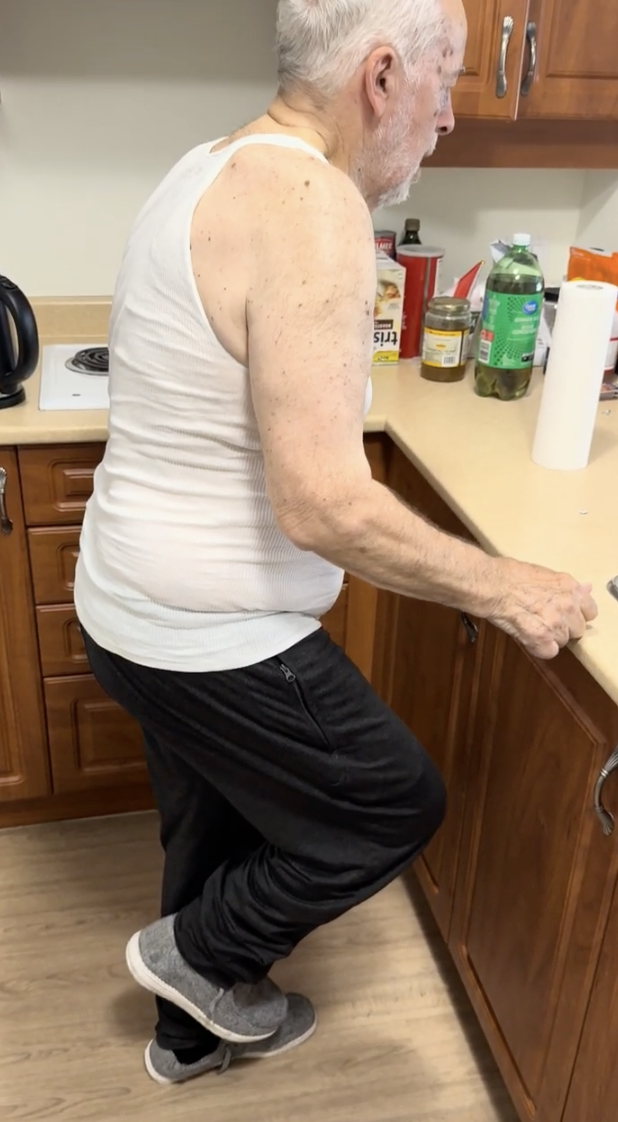
How to Practise Supported Single-Leg Balance
Set up the area
- Use a sturdy, fixed counter or another stable surface recommended by your physiotherapist.
- Clear the surrounding area of loose rugs, cords, water, pets, and other potential hazards.
- Wear appropriate footwear if recommended.
- Stand close enough to the support that you can reach it immediately.
- Have another person nearby if supervision has been recommended.
Perform the exercise
- Stand upright with both feet on the floor.
- Begin with the recommended amount of hand support.
- Slowly shift your body weight toward the standing leg.
- Lift the opposite foot only if you can do so safely and your weight-bearing precautions allow it.
- Keep your body upright and look forward.
- Hold the position only while you remain controlled.
- Return the lifted foot to the floor.
- Regain a stable position before repeating.
Avoid holding your breath and do not force yourself to remain on one leg once you begin losing control.
How Much Support Should You Use?
The appropriate amount of support is different for everyone.
A possible progression may include:
- Both hands providing firm support
- Both hands with lighter pressure
- Fingertip support
- One-hand support
- Hands hovering close to the support
Not everyone needs to reach the final stage.
Following hip surgery, the progression should depend on weight-bearing restrictions, strength, balance, symptoms, confidence, and the specific surgical procedure.
If you need hand support to perform the exercise safely, continue using it.
Why Is This More Than a Balance Exercise?
Standing on one leg after hip surgery should not simply be treated as a test of how many seconds someone can hold the position.
The exercise can have a more functional purpose.
As rehabilitation progresses, single-leg control may contribute to the ability to accept weight through the recovering leg and maintain stability during movements such as walking and stepping.
This creates an important connection between balance training and everyday mobility.
The goal is not necessarily to become good at standing still on one leg. It is to develop control that can eventually carry over into movement.
How Long Should You Stand on One Leg?
There is no universal target time after hip surgery.
The appropriate duration depends on the individual’s stage of recovery, balance, strength, surgical precautions, and ability to maintain control.
A physiotherapist may recommend several short, controlled attempts rather than trying to hold the position for as long as possible.
Stop the attempt if:
- You need to suddenly grab the support
- You begin leaning excessively
- Your standing foot moves repeatedly
- You cannot maintain control
- You experience increasing pain
- You feel dizzy or unwell
Quality and safety are more important than achieving a particular number of seconds.
Common Mistakes to Avoid
Trying single-leg balance too early
Do not begin simply because the exercise is commonly used in rehabilitation. Your weight-bearing status and surgical precautions must allow it.
Removing hand support too quickly
Using less support does not automatically make rehabilitation better. Progress gradually.
Standing too far from support
A counter or other support is only useful if you can reach it immediately when needed.
Using unstable furniture
Avoid relying on movable chairs, folding tables, rolling furniture, or anything that could shift.
Lifting the opposite leg too high
The goal is balance and control. The opposite foot generally only needs to clear the floor unless your physiotherapist has prescribed something different.
Continuing despite losing control
Repeatedly hopping, twisting, or grabbing the counter may indicate that the current version is too difficult.
Who Should Seek Professional Guidance Before Trying This Exercise?
Speak with your surgeon or physiotherapist before attempting single-leg balance independently if you:
- Have recently undergone hip surgery
- Have weight-bearing restrictions
- Are unsure about your surgical precautions
- Cannot stand safely without assistance
- Have significant pain while standing
- Have fallen recently or frequently
- Experience dizziness or faintness
- Use a walking aid and are unsure how to exercise safely
- Have new weakness, numbness, or other neurological symptoms
Some people may need to begin with different standing or weight-shifting exercises before progressing to single-leg balance.
Balance Is Only One Part of Hip Rehabilitation
Single-leg control can be useful, but recovery after hip surgery should not rely on one exercise alone.
Depending on the individual, post-surgical rehabilitation may also include:
- Hip strengthening
- Range-of-motion exercises
- Walking and gait practice
- Weight-shifting exercises
- Balance training
- Sit-to-stand practice
- Stair training
- Endurance exercises
- Walking-aid assessment
- Functional activities
The rehabilitation program should gradually connect these physical improvements to the movements the person needs in everyday life.
In-Home Hip Rehabilitation in Surrey, Langley, White Rock, Delta, and Richmond
FisioMed Mobile Clinic provides in-home post-surgical physiotherapy throughout:
- Surrey
- Langley
- White Rock
- Delta
- Richmond
Recovering at home gives the physiotherapist an opportunity to assess mobility in the environment where everyday movement actually occurs.
Mobile post-surgical physiotherapy may include:
- Hip strength and mobility exercises
- Supported balance training
- Walking and gait rehabilitation
- Weight-bearing progression when appropriate
- Stair practice
- Transfer training
- Walking-aid assessment
- Home-safety recommendations
- Personalized home-exercise programs
For someone recovering from hip surgery, avoiding unnecessary travel to a clinic may also make accessing rehabilitation more convenient.
Hip Recovery Happens One Step at a Time
Rebuilding strength is an important part of hip rehabilitation, but strength alone does not tell the whole story.
When appropriate for the stage of recovery, supported single-leg balance can help challenge the stability and control needed when placing weight through one leg during everyday movement.
The goal is not simply to stand on one leg for longer. It is to gradually rebuild the control needed for walking and other meaningful activities.
Looking for post-surgical hip physiotherapy at home in Surrey, Langley, White Rock, Delta,Contact FisioMed Mobile Clinic to arrange an in-home physiotherapy assessment.
This article provides general education and does not replace individualized medical or physiotherapy advice. Single-leg balance should only be performed when appropriate for the individual’s surgical procedure, weight-bearing status, precautions, strength, and balance.


Leave A Comment