
Learn how heel raises can help seniors strengthen the calf muscles used during walking and push-off. FisioMed Mobile Clinic provides in-home physiotherapy in Surrey, Langley, White Rock, Delta, and Richmond.
Heel Raises for Seniors: Building Strength for Every Step
Heel raises may look like a simple calf exercise, but the muscles they target play an important role in everyday walking.
As we walk, the calf muscles help control the ankle and contribute to push-off as the heel rises from the ground and the body moves forward into the next step. For seniors, maintaining strength in these muscles can be an important part of supporting everyday mobility.
Heel raises can be incorporated into a broader strengthening and mobility program when appropriate for the individual. They can also be modified by changing the amount of hand support, range of movement, repetitions, and difficulty.
The goal is not simply to complete as many heel raises as possible. The goal is to build strength that has a purpose in everyday movement.
What Happens at the Ankle When We Walk?
Walking involves a coordinated sequence of movements through the hips, knees, ankles, and feet.
Toward the later part of each step, the heel begins to rise from the ground. The calf muscles contribute to controlling the ankle and helping the body progress forward as you prepare for the next step.
This is why calf strength is about more than simply being able to rise onto your toes.
The muscles involved are used repeatedly whenever we walk around the home, move through the community, or spend time on our feet.
Why Are Heel Raises Useful for Seniors?
Strength can change with age, illness, injury, surgery, inactivity, or extended periods of reduced mobility. If the calf muscles become weaker, this may affect how effectively they contribute during walking.
Heel raises provide a simple way to work these muscles in a standing position.
For suitable seniors, heel raises may be incorporated into a rehabilitation program to work on:
- Calf strength
- Ankle control
- Push-off during walking
- Standing strength
- Everyday mobility
- Lower-leg endurance
However, heel raises are only one exercise. Walking depends on many different physical abilities, including hip and leg strength, balance, joint mobility, coordination, and endurance.
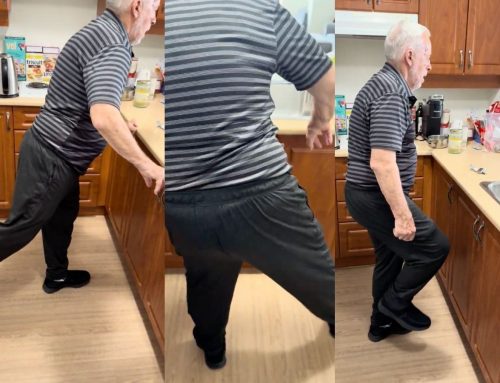
How to Perform a Supported Heel Raise
Set up the area
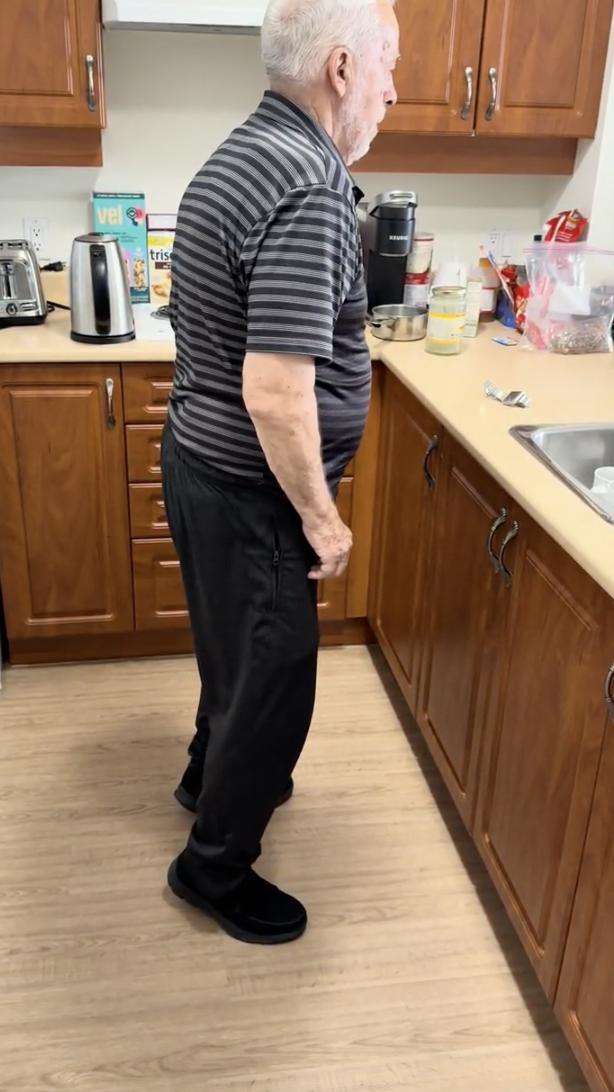
- Stand facing a sturdy, fixed counter or other stable support.
- Keep your feet comfortably apart.
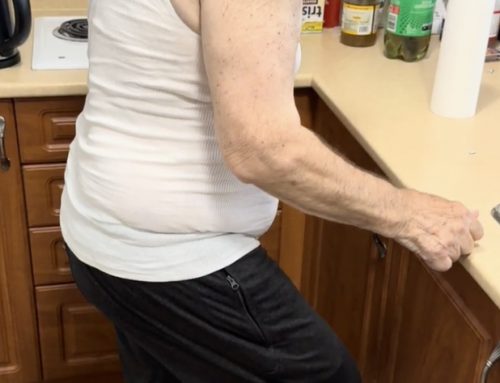
- Place your hands on the counter as needed for balance.
- Stand upright and look forward.
- Make sure the floor is clear of loose rugs, cords, water, or other hazards.
- Wear secure footwear if recommended by your physiotherapist.
Perform the exercise
- Begin with both feet flat on the floor.
- Slowly lift your heels from the ground.
- Rise onto the balls of your feet only as high as you can comfortably control.
- Keep the movement slow and steady.
- Lower your heels back toward the floor with control.
- Repeat according to the number recommended for you.
Continue breathing normally throughout the exercise and avoid rushing through the repetitions.
Why Does Control Matter?
The goal of a heel raise is not simply to get the heels as high as possible.
A slower, controlled movement allows the exercise to focus on the muscles responsible for raising and lowering the heels. If someone needs to bounce, lean heavily through the arms, or use momentum to complete the movement, the exercise may need to be modified.
For seniors, quality of movement is generally more useful than simply increasing the number of repetitions.
A physiotherapist can adjust the exercise based on the person’s current strength and ability.
How Can Heel Raises Be Progressed?
There is no single progression that is appropriate for every senior.
Depending on the individual, a physiotherapist may modify:
- The amount of hand support
- The range of the heel raise
- The number of repetitions
- The number of sets
- The speed of the movement
- The exercise position
- The overall difficulty
Someone who needs both hands firmly on a counter should not remove that support simply because another person can perform the exercise without holding on.
The appropriate level should challenge the muscles while allowing the person to remain safe and controlled.
Common Mistakes to Avoid
Moving too quickly
Bouncing up and down can reduce control. Try to raise and lower the heels gradually.
Using an unstable support
Do not rely on movable chairs, rolling furniture, or other objects that could shift unexpectedly.
Leaning heavily through the arms
Some hand support may be necessary for balance, but excessive pushing through the arms can change how the exercise is performed.
Forcing the movement
Work within a comfortable and appropriate range rather than trying to lift the heels as high as possible.
Progressing before you are ready
Reducing hand support or making the exercise more difficult should only occur when the current version can be performed safely.
Continuing through concerning symptoms
Stop the exercise if you experience significant pain, dizziness, unusual shortness of breath, sudden weakness, or other concerning symptoms.
Who Should Seek Professional Guidance First?
Speak with a physiotherapist or physician before performing heel raises independently if you:
- Have recently had surgery or an injury
- Have weight-bearing restrictions
- Have significant balance difficulties
- Have fallen recently or frequently
- Cannot stand safely without assistance
- Have significant foot, ankle, knee, or calf pain
- Have new weakness or numbness
- Use a walking aid and are unsure how to exercise safely
- Are uncertain whether the exercise is appropriate for you
Some individuals may need a different starting exercise or direct supervision.
Heel Raises Are Only One Part of Walking Training
Stronger calves can contribute to walking, but walking ability depends on much more than one muscle group.
A comprehensive senior mobility program may also include:
- Hip and leg strengthening
- Balance exercises
- Walking practice
- Functional exercises
- Ankle and lower-body mobility
- Endurance training
- Appropriate use of walking aids
- Stair practice
A physiotherapist can determine which areas need attention and build a program around the individual’s mobility, health, environment, and goals.
Mobile Physiotherapy for Seniors in Surrey, Langley, White Rock, Delta, and Richmond
FisioMed Mobile Clinic provides in-home physiotherapy for seniors throughout:
- Surrey
- Langley
- White Rock
- Delta
- Richmond
A home visit allows the physiotherapist to assess how the person actually walks and moves within their everyday environment.
Mobile physiotherapy may include:
- Strength and mobility assessment
- Personalized strengthening exercises
- Walking and gait training
- Balance and fall-risk assessment
- Functional rehabilitation
- Walking-aid assessment
- Stair practice
- Home-safety recommendations
- Personalized home-exercise programs
Rather than requiring the senior to travel to a clinic, FisioMed brings physiotherapy directly to the place where everyday movement happens.
Small Exercise. Everyday Purpose.
Heel raises are a relatively simple exercise, but they can have a practical purpose.
The calf muscles contribute to ankle control and push-off during walking. When appropriate, heel raises can be one way for seniors to strengthen these muscles as part of a broader mobility program.
The amount of support, repetitions, range, and progression should always reflect the individual’s current abilities.
Looking for senior mobility or strengthening physiotherapy at home in Surrey, Langley, White Rock, Delta, or Richmond? Contact FisioMed Mobile Clinic to arrange an in-home physiotherapy assessment.
This article provides general education and does not replace individualized medical or physiotherapy advice. Exercise selection, support, and progression should reflect the individual’s health, balance, mobility, and abilities.

Leave A Comment